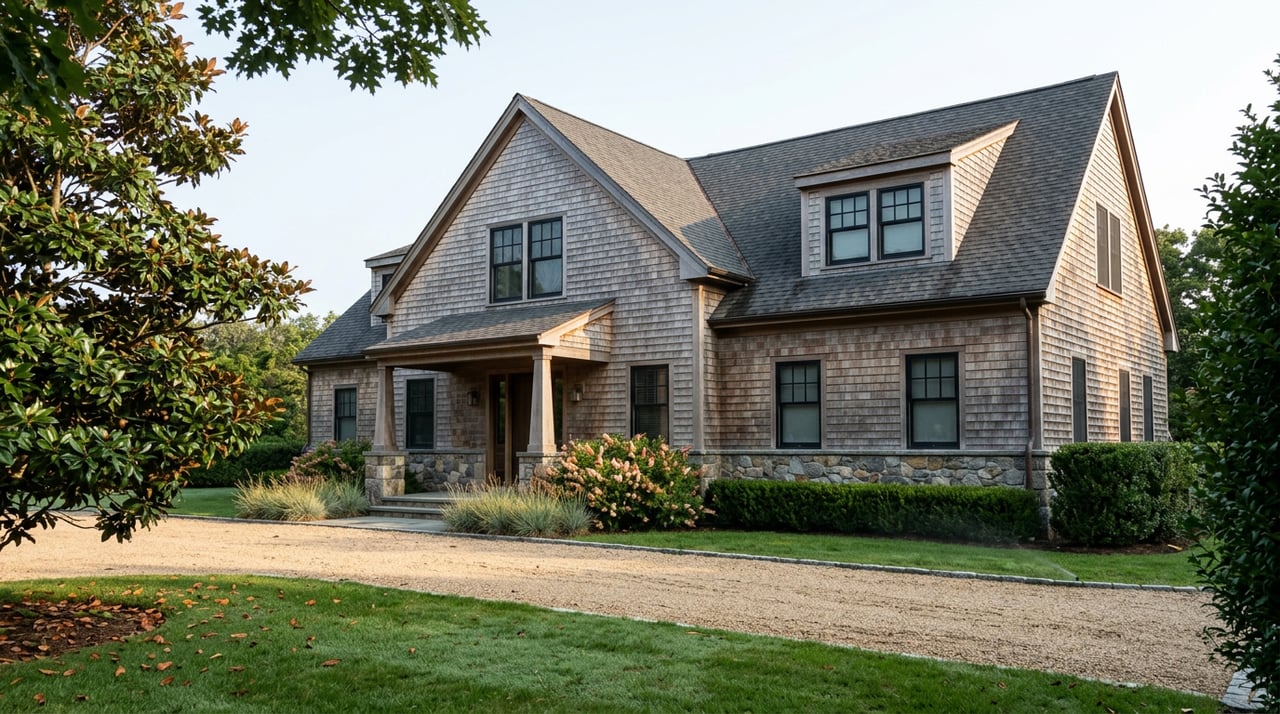
Port Washington Isn't a Town. It's Four Governments Sharing One Zip Code
August 20, 2026
August 20, 2026
Ask someone who has lived on the Port Washington peninsula for twenty years what town they live in, and you will get a pause before the answer. That pause is not confusion. It is accuracy. The honest answer depends on which side of a line their house sits on, and that line rarely shows up on a listing sheet.
The peninsula's own community site puts the confusion in writing for anyone searching for a mayor's office that doesn't exist:
"There is no such town as, 'Port Washington, New York'"
What most people call Port Washington is a hamlet governed directly by the Town of North Hempstead, which is not the same thing as having its own municipal government. Layered on top of that hamlet sit five incorporated villages, each running its own local affairs. Layered again on top of all of it are two special districts, elected separately from any village board, that decide where your water comes from and where your wastewater goes. A single address can answer to as many as four of these authorities at once, and the combination changes block by block. Even school enrollment doesn't track the hamlet cleanly. Some students who live inside the Port Washington school district have a mailing address the Postal Service still files under neighboring Manhasset.
For a buyer comparing Port Washington to a more straightforwardly governed Long Island town, this matters more than the median price on a portal listing. The median tells you what a house costs. It tells you nothing about which of these overlapping authorities actually runs your street.
The five incorporated villages sharing the Port Washington peninsula didn't form at the same time or for the same reasons, and their differences are still visible in how each one governs today.
None of these differences are visible from a street view photo. They are only visible if you ask the right question of the right office, which is exactly the step most out-of-area buyers skip.
The most consequential of the two special districts is the Port Washington Water Pollution Control District, a public sewer district established in 1915 as a special improvement district under the Town of North Hempstead. Its own description of its service area names the hamlet of Port Washington, the Village of Port Washington North, and only portions of Baxter Estates and Flower Hill. Manorhaven's sewage gets treated there too, but under a separate contract, since Manorhaven collects its own wastewater through its own village system and then hands it off to the district's treatment plant.
Sands Point does not appear on that service list. If you're shopping in Sands Point specifically, that omission is worth a direct question to the village rather than an assumption carried over from the rest of the peninsula. Whatever wastewater arrangement applies there, it is not automatically the shared system that serves Port Washington proper, Port Washington North, and parts of two other villages. This is the kind of detail that never shows up in a listing description and rarely comes up until an inspection or a title search forces the question.
The district itself is governed by an elected board of commissioners serving staggered three-year terms, currently under superintendent Windsor "Win" J., and it owns real infrastructure well beyond pipes. Sunset Park, the waterfront park along Manhasset Bay that sits partly in the hamlet and partly in Baxter Estates, is district property, built on landfill extended into the bay back when the plant was first constructed. In 2022 the district applied for a $5.85 million grant to rehabilitate more than 16,000 linear feet of gravity sewer main, funding that was later awarded through the state's Water Quality Improvement Project program. That is not abstract municipal housekeeping. Aging sewer infrastructure and the money to fix it are exactly the kind of long-horizon cost a buyer benefits from understanding before closing, not after.
The second special layer is the Port Washington Water District, established in 1913 and governed by its own three-member board of elected commissioners, currently chaired by David R. Brackett with Peter Meyer as secretary and Mindy Germain as treasurer. This board answers to no village and to no hamlet civic association. It answers to voters within its own district lines, and it makes decisions about where drinking water physically comes from.
That decision has already led the district to build major infrastructure outside the peninsula entirely. Roughly two-thirds of the district's total water supply now comes from the Morley Park Wells, constructed at Christopher Morley Park in the Village of North Hills, miles inland from Port Washington, specifically because wells directly on the peninsula face a real risk of saltwater intrusion into the aquifer. A second well sits at Stonytown Road in Flower Hill Park, inside the sliver of Flower Hill that touches the peninsula, built there in the 1980s to move away from a former landfill site and reconstructed again in the 2020s.
None of this changes what comes out of a kitchen faucet day to day. It does mean that a resource as basic as water supply on this peninsula is managed by a board most buyers never think to ask about, making infrastructure decisions with consequences that outlast any single sale.
None of this should read as a warning against buying here. It should read as a map of the questions a generic listing can't answer for you. Before writing an offer on the peninsula, it is worth confirming, address by address, not neighborhood by neighborhood:
A title search will eventually surface most of this. The advantage of asking earlier is that it changes how you read the rest of the deal, not just the closing documents.
Does living in an incorporated village mean lower taxes than the unincorporated hamlet? Not necessarily. Incorporation adds a village tax line but also adds village-run services and local control that the unincorporated hamlet doesn't have on its own. The comparison depends on the specific village budget and the specific services it funds, not a blanket rule.
If two houses are both in Port Washington North, do they answer to the same water and sewer authorities? Village membership and special district membership are separate questions. A shared village address does not guarantee shared water or sewer district membership, since district boundaries were drawn independently of village lines.
Who do I actually call to confirm this before making an offer? The relevant village clerk's office is the right starting point for village jurisdiction, and the water and sewer districts each maintain their own public offices for service area questions. A local agent who works this peninsula regularly can help route the right questions to the right office instead of guessing from an address alone.
Port Washington's layered governance is not a red flag. It is simply a detail that rewards a buyer who asks about it early rather than one who assumes the peninsula behaves like a single town. If you're comparing Port Washington to another North Shore option and want a clear-eyed read on what a specific address actually answers to, Michelle Norris is glad to walk through it with you. Let's Connect.
Stay up to date on the latest real estate trends.

From your first consultation to the closing table, Michelle is committed to making your real estate journey smooth, informed, and successful. Whether you're preparing to sell, searching for your next home, or exploring Long Island's 55+ communities, Michelle provides the expertise, strategy, and personal attention needed to achieve your goals.
MICHELLE NORRIS
(516) 512-0920
[email protected]
1000 Park Blvd
Massapequa Park, NY 11762